

Reflections
July 2025
If you’ve followed Mary Stanley’s work at all, on this new website you’ll recognize many pieces from past years, including the series she calls “the Chimeras,” begun in 2014. With that departure from her previous vessels and wall plaques, Stanley began producing entire intricate 3-D constructions, scenes through which she explores unsettling and seemingly intractable questions around miscegenation, identity, and that host of human extremity embodied in the dry and inadequate phrase “the migrant crisis.” Many pieces here are not new, but this website presents that work differently and provides a new path for how we may engage with it.
Two things are immediately striking: almost no text accompanies this work and there’s a new photographer. It’s a truism that we “read” text linearly but we see images “all at once.” The critic David Levi Strauss has even said that text and image are so inherently antithetical that mentioning one sets up a fight with the other (Levi Strauss also says we have left the age of text and are now in the age of images and magic). However, much of Stanley’s work has pried this binary apart, collapsed it, folded it up, stretched it, explored thoroughly how text may partner with image after all. Her often lengthy exhibition wall texts provide the narrative of what’s happening in each Chimera piece, the concept she’s working with, and the often classical reference that she may use as a scaffold for the piece. Along with such accompanying texts about the work, she has embedded text as a graphic element within some work, sometimes a visual pun. She has transferred chunks of printed text onto surfaces, its minute size sometimes blurring legibility even as it heightens an unmistakable resemblance to ancient incised clay tablets, reminding us these ancient roots are closer than we think. Some of this work also reminds me of the artist Cui Fei, whose photograms of twigs and tendrils evoke Chinese characters in a “manuscript of nature.”
So I expected more text here too. I was surprised when I asked Stanley if the website were “finished” yet and how she intended to employ texts with these images. “Oh, I think it’s pretty much done,” she replied.
“Oh!” I said to myself. “I’d better have another look here.” Aloud, I asked, “And who took these photos of your work? It looks like you’ve got a new photographer.”
“I took them,” she said. Such a happy departure, excellent as the previous photos may have been! Photographing your own work may be a little like looking in the mirror; indeed Stanley seems to see all living beings as her mirror too. Here you can readily see that Stanley has what the photographer Carrie Mae Weems calls “a tender eye.” In these new images, the tender jostles with the long artistic tradition of the grotesque, revealing what the maker saw first and intended. This has two effects.
Recall the original notion of the Chimera from Greek mythology: a fearsome fire-breathing mash-up of different creatures - in those days, lion, goat, and snake - meant to be monstrous and horrific, both warning and destroyer. A Chimera may also be a monstrous or unnatural or heretical idea - to believers in racial purity, race-mixing is monstrosity incarnate.
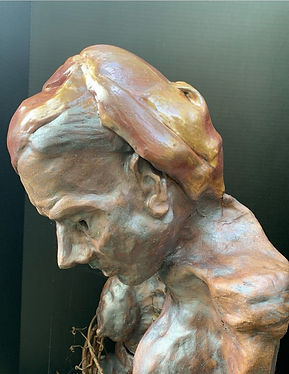
Yet these Chimeras are winsome creatures, most often part bird to part human, evoking flight, the delicate, sometimes the droll, sometimes the mysterious egg of creation, both fierce and fragile. So the first effect of these new photographs is a softening of the monstrous, allowing us a glimpse beneath. The grotesque in art, with its exaggeration and distortion and editing out of some details, always poses a risk that what lies beneath may remain unseen. In these photographs, Stanley gets us closer to seeing what she sees, closer to open-hearted curiosity than flight or fight. She knows where to look. You can see this immediately in the cover image with its soft golden sheen falling over the head of the first figure. The grotesque also poses a risk for the artist: that we may mistake its blunt methods for the naive or the primitive. This leads to the second effect of this new set of images of Stanley’s work: clearly there is nothing naive or primitive in her skill. She is the exceptionally deft and intentional and able draftswoman you have always suspected. And these objects are closer than they may appear.
- Nancy Keefe Rhodes
“Thank you for making me think, reconsider and wonder. Imaginative Cathedral of sorrows and sins of our world.”
Anonymous
“Words cannot express my wonderment & awe …. Thank you!”
Martha Stewart 7/13/24
“I’m a photographer and was absolutely moved with the depth and emotion coming from the pieces. … Thank you for making me feel through this!” Anonymous 7/14/2024
“Captivating & thought provoking. I especially enjoyed the juxtaposition between the Bible and evolution — not adversaries after all. Beautiful Work.” Anonymous
“Everything is connected in energy. There is soul in every piece.”
Marian Giroud
“Mary, your work is brilliant in conception, execution and articulation. Beautiful and thought provoking. Words. Words. Words! So perfectly named. It surely evoked my Catholic upbringing. The way you frame each problem moves me beyond the simplistic…..”
Michael Messina-Yauchzy
“My son liked Apex Species—said it reminded him of Greek Mythology.”
Joe
“I love the work. Thought provoking. Hope we can get back to being able to talk to each other. Differences don’t have to divide. Thanks.”
Kay White